

High housing costs cut into Texans’ income gains in 2025 While Incomes Dropped in McAllen Area
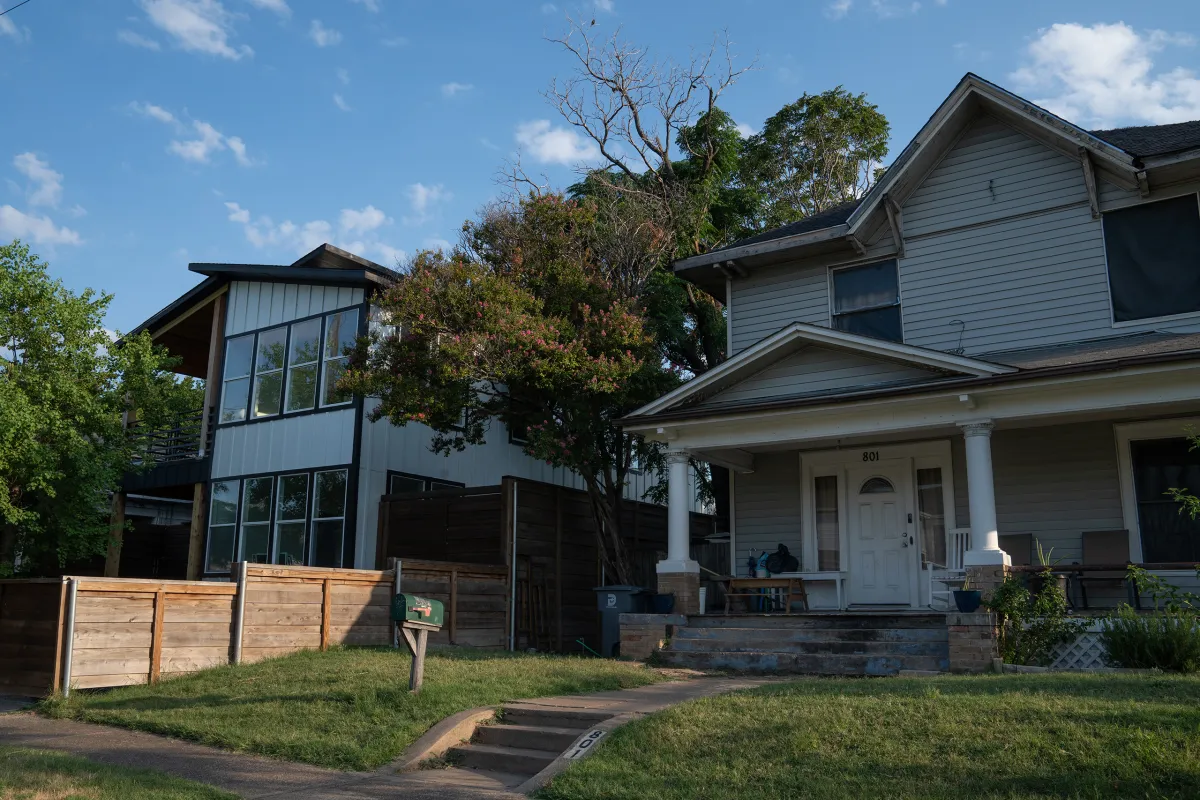
Photo above: Newly developed apartments sit next to older homes in the Oak Cliff neighborhood of Dallas on July 11, 2024. Azul Sordo for the Texas Tribune
by Joshua Fechter and Dan Keemahill, The Texas Tribune
Incomes largely slowed in Texas last year, and fell dramatically in at least one major urban area, as Texans face considerable and sustained pressure from high housing costs, the U.S. Census Bureau said Thursday.
The state’s median household income sat at $82,625 in 2025, census data shows, up slightly from the previous year and with Hispanic households making the biggest gains.
Those gains weren’t evenly spread geographically. While incomes grew in the Houston and San Antonio regions, they fell in the McAllen and Dallas-Fort Worth regions. And while household incomes have largely grown since 2021, Texas lags the national median household income of $84,780.
Fewer Texans, including children, lived in poverty last year and Texas’ poverty rate shrank. But the number of older Texans and families living in poverty ticked up. Income inequality remains high in Texas, but is lower than the rest of the country.
Housing costs remain a pain point for many Texans as voters in this year’s elections fret about the cost of living.
More than half of the state’s 4.3 million renters were “cost-burdened,” meaning that for every $10 they bring home, three go to keeping a roof over their heads. That means fewer dollars remain to buy groceries, go to the doctor, cover their transportation, pay for child care or build savings. But monthly rents were largely flat for Texas tenants.
Meanwhile, the amount of money Texas homeowners spent on housing ticked up, particularly for those with a mortgage. The share of homeowners with a mortgage considered cost-burdened grew slightly to about 32% in 2025.
Hispanic and Black households saw the biggest gains in their household incomes, now typically making $70,348 and $64,664, respectively. Those incomes still fall significantly behind white households at $92,479. And the pay gap between white and Hispanic households is wider in Texas than it is nationally. The median household income among Texans of Asian descent sits at $122,370, which fell 2.3% in 2025.
While housing costs grew overall, there was some relief. The median property tax bill for a homeowner who has paid off their mortgage shrank about 4.2% from 2024 to 2025. For homeowners with a mortgage, that bill was essentially flat. Texas lawmakers have spent billions of dollars since the start of the decade to rein in the state’s high property taxes.
Nationally, the median property tax bill grew, but was still lower than the typical bill in Texas.
The Census Bureau changed its survey questions related to health insurance, but the estimates showed Texas still has the nation’s highest uninsured rate, a ranking it has maintained for more than a decade.
The agency added survey questions about solar panel and electric vehicle ownership. Households in Travis County, home to Tesla’s Gigafactory, were about twice as likely to own an electric vehicle compared to the state as a whole.
Households in urban areas owned solar panels at higher rates than those in rural areas, but more than 80,000 rural households out of 2.3 million reported having them, according to the Census. Texas trailed the national rate of 5.2% of homes with solar panels.
This article first appeared on The Texas Tribune.
High housing costs cut into Texans’ income gains in 2025, new Census data shows
by Joshua Fechter and Dan Keemahill, The Texas Tribune
October 29, 2026
Incomes largely slowed in Texas last year, and fell dramatically in at least one major urban area, as Texans face considerable and sustained pressure from high housing costs, the U.S. Census Bureau said Thursday.
The state’s median household income sat at $82,625 in 2025, census data shows, up slightly from the previous year and with Hispanic households making the biggest gains.
Those gains weren’t evenly spread geographically. While incomes grew in the Houston and San Antonio regions, they fell in the McAllen and Dallas-Fort Worth regions. And while household incomes have largely grown since 2021, Texas lags the national median household income of $84,780.
Fewer Texans, including children, lived in poverty last year and Texas’ poverty rate shrank. But the number of older Texans and families living in poverty ticked up. Income inequality remains high in Texas, but is lower than the rest of the country.
Housing costs remain a pain point for many Texans as voters in this year’s elections fret about the cost of living.
More than half of the state’s 4.3 million renters were “cost-burdened,” meaning that for every $10 they bring home, three go to keeping a roof over their heads. That means fewer dollars remain to buy groceries, go to the doctor, cover their transportation, pay for child care or build savings. But monthly rents were largely flat for Texas tenants.
Meanwhile, the amount of money Texas homeowners spent on housing ticked up, particularly for those with a mortgage. The share of homeowners with a mortgage considered cost-burdened grew slightly to about 32% in 2025.
Hispanic and Black households saw the biggest gains in their household incomes, now typically making $70,348 and $64,664, respectively. Those incomes still fall significantly behind white households at $92,479. And the pay gap between white and Hispanic households is wider in Texas than it is nationally. The median household income among Texans of Asian descent sits at $122,370, which fell 2.3% in 2025.
While housing costs grew overall, there was some relief. The median property tax bill for a homeowner who has paid off their mortgage shrank about 4.2% from 2024 to 2025. For homeowners with a mortgage, that bill was essentially flat. Texas lawmakers have spent billions of dollars since the start of the decade to rein in the state’s high property taxes.
Nationally, the median property tax bill grew, but was still lower than the typical bill in Texas.
The Census Bureau changed its survey questions related to health insurance, but the estimates showed Texas still has the nation’s highest uninsured rate, a ranking it has maintained for more than a decade.
The agency added survey questions about solar panel and electric vehicle ownership. Households in Travis County, home to Tesla’s Gigafactory, were about twice as likely to own an electric vehicle compared to the state as a whole.
Households in urban areas owned solar panels at higher rates than those in rural areas, but more than 80,000 rural households out of 2.3 million reported having them, according to the Census. Texas trailed the national rate of 5.2% of homes with solar panels.
This article first appeared on The Texas Tribune.